
Am I Depressed or Just Sad?

Updated: Apr 19
By Dr. Pankaj Borade, Consultant Psychiatrist · Mind Matters Clinic, Camp, Pune · 12+ years experience · Ruby Hall Clinic affiliate
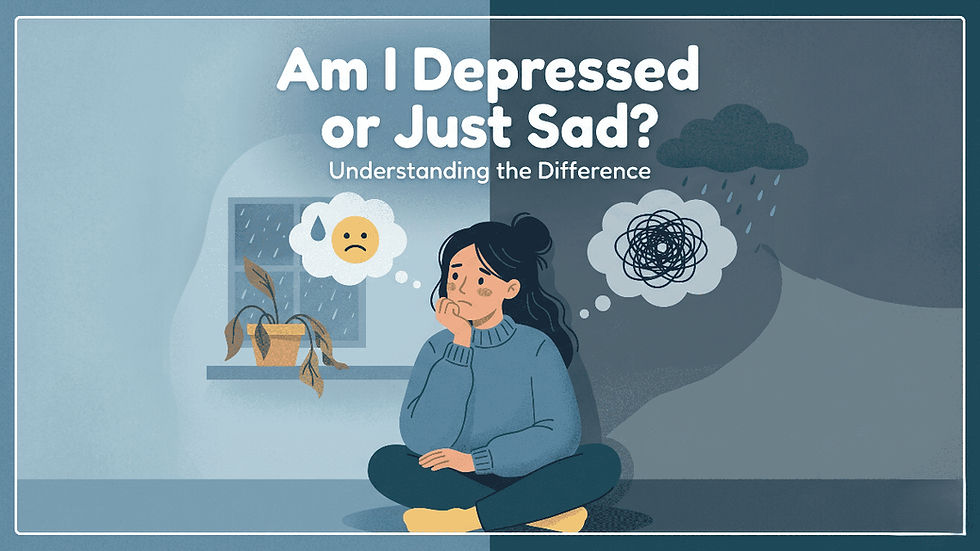
There’s a question I hear almost every week in my clinic in Pune City. Sometimes it comes out directly. Sometimes it hides behind other words. But the question is always the same:
“Do you think I’m depressed — or am I just sad?”
It’s one of the most important questions you can ask yourself. And the fact that you’re asking it already tells me something good about you — you’re paying attention to your own mind. That takes courage.
But here’s the problem: in India, we don’t always have the vocabulary to make this distinction. We grow up hearing things like"sab theek ho jayega" or "bas thoda time lagega." or And sometimes, that’s true. Sometimes sadness does pass on its own. But sometimes, what we call "bas mood kharab hai" is actually something deeper — something that deserves attention, not dismissal.
So let me walk you through the difference. Not as a textbook definition, but as a conversation — the same one I have with my patients, sitting across from them in my clinic.
Sadness Is a Visitor. Depression Moves In.
Sadness is one of our most natural emotions. You lose a loved one — you grieve. A relationship ends — you feel heartbroken. You don’t get the promotion you worked for — you feel disappointed. These are appropriate emotional responses to difficult life events.
Sadness has a cause you can usually name. It comes, it hurts, and over days or weeks, it begins to soften. You still laugh at a friend’s joke. You still enjoy your chai. You still look forward to the weekend, even if only a little.
Depression is different. Depression doesn’t always need a reason. It can arrive even when everything in your life looks “fine” on the outside. And instead of softening with time, it deepens. It stays.
So How Do You Tell the Difference?
In my 12+ years of clinical practice, I’ve found that a few patterns help people understand where they stand. These are not diagnostic criteria — only a proper clinical evaluation can determine that. But they can help you reflect honestly.
1. Duration
Sadness usually fades within a few days to a couple of weeks. If your low mood has persisted for more than two weeks, nearly every day, and doesn’t seem to be lifting — that’s a signal worth paying attention to.
2. Functioning
When you’re sad, daily life is harder, but you manage. You go to work. You eat. You sleep — maybe a little more or a little less than usual, but roughly on track.
With depression, functioning starts to break down. You can’t concentrate at work. You stop replying to messages. Getting out of bed feels like a physical effort. Things you used to enjoy — your morning walk, cooking, meeting friends — start feeling pointless.
3. Physical Symptoms
This is one most people in Pune — and across India — overlook. Depression isn’t just “in your head.” It shows up in your body. Unexplained fatigue. Persistent headaches. Appetite changes — either eating too much or not wanting to eat at all. Sleep disruption — either sleeping 12 hours or barely sleeping 4.
I’ve had patients come to me after months of visiting other doctors for body aches, stomach issues, and fatigue. When we sit and talk, the picture becomes clearer. The body was speaking what the mind couldn’t.
4. Self-Worth
If you’ve started feeling like a burden to your family, like nothing you do matters, or like the world would be better off without you — please don’t brush that aside. That’s not sadness talking. That’s depression distorting how you see yourself.
5. Interest and Pleasure
One of the hallmarks of depression is something we call anhedonia — the inability to feel pleasure. You don’t just feel sad about one thing; you lose interest in almost everything. The cricket match doesn’t excite you. The festival feels like a chore. Even food tastes bland.
When sadness is at play, you can still access joy in other areas. Depression takes that access away.
Why This Matters in India
We live in a culture that often values endurance over expression. "Strong raho." "Sab handle kar lo." Many of my patients — especially men — wait months, sometimes years, before seeking help. By that time, the depression has deepened, relationships have strained, and work has suffered.
Here in Pune, I see this across demographics — IT professionals in Hinjewadi burning out silently, homemakers in Kothrud carrying the weight of a family’s emotions alone, college students near Fergusson College wondering why they can’t feel happy even when exam results are fine.
The numbers confirm what I see in my clinic every day. India's National Mental Health Survey by NIMHANS found that 1 in 20 Indians lives with depression — and the treatment gap for depressive disorders stands at 85%. That means for every 20 people who need help, 17 are not getting it.
Depression is not a weakness. It’s not a character flaw. It’s a medical condition — as real as diabetes or hypertension. And like those conditions, it responds to treatment.
If you're looking for a psychiatrist in Pune, the most important thing isn't finding the most well-known name — it's finding someone you can speak to honestly, without fear of judgment.
One Story That Stayed With Me
The following is a composite narrative — details have been changed and combined to protect confidentiality. It is illustrative, not a real case.
Rohit was 34, an IT project manager in Hinjewadi. He came to my clinic not because he thought he was depressed — but because he hadn’t slept properly in four months and his wife had started asking if everything was okay at work.
He was certain it was stress.
But when we talked, the picture was different. He hadn’t watched cricket in weeks — and he was the kind of person who used to set alarms for matches. He was eating at his desk alone, skipping lunch with colleagues he’d known for years. He told me he felt like he was “going through the motions” — present in every meeting, absent from his own life.
“I don’t feel sad exactly. I just don’t feel much of anything.”
That last line is something I hear often. It’s one of the clearest descriptions of anhedonia I know — and it came not from a textbook, but from a software engineer in Pune trying to explain why he couldn’t enjoy his own birthday dinner.
The release came and went. The feeling didn’t.
Rohit wasn’t lazy, weak, or ungrateful. He was depressed — and like many people, he had no framework to recognise it because it didn’t look like what he’d imagined depression to look like. No crying. No dramatic breakdown. Just a quiet, persistent flatness that had slowly taken the colour out of everything.
He got better. It took time, the right support, and his own courage to keep showing up. But he got better.
I share this because Rohit is not unusual. In my clinic, I see versions of this story every week — across ages, professions, and backgrounds. The details change. The core feeling doesn’t.
When Should You Seek Help?
You don’t need to wait until things are “bad enough.” That’s one of the biggest myths I encounter. There’s no minimum threshold of suffering required before you deserve support.
But here are a few signs that it’s time to talk to a professional:
Your low mood has lasted more than two weeks and isn’t improving
You’ve lost interest in things you used to enjoy
Your sleep, appetite, or energy levels have changed significantly
You’re withdrawing from people or responsibilities
You’ve had thoughts that life isn’t worth living
If even one of these feels familiar, please reach out. Not because something is “wrong” with you, but because something can get better — and you deserve that.
Distance is no longer a barrier — online psychiatry consultation is now widely available across India, which means wherever you are, a proper clinical conversation is closer than you think.
A Quick Note on Anxiety
Many people also ask me: "Am I anxious or just stressed?" The distinction is similar. Stress is a response to a known pressure — a deadline, a conflict, a financial worry. Anxiety is when the worry persists beyond the stressor, becomes disproportionate, or starts interfering with your daily life.
Often, depression and anxiety coexist. You don’t have to figure it out alone. That’s what a proper clinical conversation is for.
Final Thought
If you’ve read this far, you’re already doing something important — you’re taking your mental health seriously. Whether what you’re feeling is sadness or depression, your feelings are valid, and help is available.
You don’t have to have all the answers before you walk into a clinic. You just have to walk in.
Frequently Asked Questions
Can depression go away on its own without treatment?
Sometimes mild depressive episodes do lift on their own, particularly if there’s a clear trigger and good social support. But moderate to severe depression rarely resolves without some form of intervention — and waiting too long often allows it to deepen. The more important question isn’t whether it can go away on its own, but whether you want to spend months finding out when support is available now.
How do I know if I need to see a psychiatrist or just a therapist?
A general rule: if your symptoms are primarily emotional and situational — relationship stress, grief, work pressure — a therapist or counsellor is often the right first step. If your symptoms include significant sleep disruption, appetite changes, physical fatigue, inability to function, or thoughts of self-harm — a psychiatrist should be involved. In many cases, both work together. A psychiatrist can assess whether medication is appropriate; a therapist works on patterns and coping. They are not competing — they are complementary.
Is it normal to feel depressed even when life is going well?
Yes — and this confuses people enormously. Depression is not a proportionate response to circumstances. It is a medical condition that can occur regardless of how objectively good your life appears. Feeling guilty for being depressed when you have a job, a family, and no obvious reason — that guilt is itself a symptom, not a verdict on your character.
What is the first step if I think I might be depressed?
Tell one person you trust — a family member, a close friend, or a doctor. You do not need to have all the answers before you reach out. A single honest conversation with a professional can clarify whether what you’re experiencing is clinical depression, another condition, or a period of intense stress that needs support. You don’t need a crisis to deserve help.
If something in this post resonated with you, you don't have to figure out the next step alone. You can book a consultation at Mind Matters Clinic — in-clinic in Camp, Pune, or online from anywhere in India or world — at www.drpankajborade.com


